























By Helen Petre
Florida is the fishing capital of the world, and the panhandle offers an incredible diversity of fishing experiences. Our emerald green, clear water, and white sand beaches provide a productive surf fishing experience, and our fresh and brackish water offer land and kayak fishing. Then, of course, there is offshore redfish, which is the life experience we all dream about.
Thankfully, though, you do not need a boat to surf fish or freshwater fish. Surf fishing for pompano is fun in spring, but as beaches get crowded and hot, freshwater fishing offers an alternative that requires little more than a pole and bait and is cooler and quieter.
One of a child’s most memorable experiences is often that first fish catch. It is an experience that can lead to a lifetime of conservation and sportsmanship and teach skill, independence, achievement and respect for nature. Kids who learn to fish, and adults who learn skills, are self-confident and dependable. Now is a great time for a family fishing experience.
What will you catch?
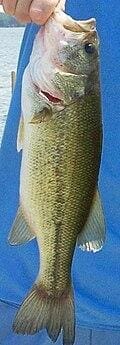
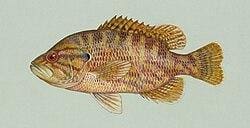
Largemouth bass (Micropterus salmoides)
Largemouth bass is the most popular game fish in North America, and Florida’s freshwater fish. Bass is everyone’s favorite warm-water fish. Bass are really fun to catch because they put up a good fight. Largemouth bass spawn in spring, and are easier to catch then, but summer is still a good time to catch them in lakes, rivers, and ponds. They prefer vegetated shorelines and live for ten years in the wild.
Bass are carnivores. In the wild, they eat fish, mollusks, and insects. The best live bait is a golden shiner hooked through the lips with a large hook (2 to #5). Use a medium rod with 14-to-20-pound test line. If using artificial bait, plastic worms work well.
Adult bass are apex predators, but young are prey for herons, larger bass, and catfish.
Catch bass in the Choctawhatchee River, accessible from Ebro, and the backwater lakes that surround the river, or fish in Holmes Creek, a spring-fed tributary of the river. Bass are plentiful in the Yellow River, which flows southwest from Alabama.
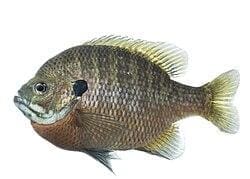
Bluegill (Lepomis macrochirus)
Besides bass, the Panhandle is an exciting place to fish for sunfish. Bluegill (or bream, or brim) are the most common summer sunfish. They are fun to catch and great to eat. These are panfish with vertical stripes. Bluegill live in rivers, streams, springs, and lakes. They spawn in summer, building nests in shallow water on sandy bottoms. Nests are in groups of about 35; a collection of shallow, scooped out areas all together in one area. The male makes the nest, invites the female to lay her eggs, and fertilizes them. Then the father-to-be guards the eggs until they hatch, in a week or so.
Bluegill eat mostly insects, but worms are the most successful bait. Use a small #6 hook with a split shot sinker about six inches up the line.
Another panfish: Redear sunfish
Redear sunfish are popular sportfish, sometimes called shellcrackers. They look like bluegill, but are slightly larger, and have a distinctive red mark on the gill cover. At home in the warm water of lakes, streams, and ponds, redear sunfish live in the vegetated areas near logs, often in groups. In warm weather, they sometimes congregate around lily pads.
Redear favorite foods are snails, clams, and mussels, hence the name shellcracker. Redear crush the shell, eat the meat, and spit out the shell fragments.
Males make nests in groups, in somewhat deeper water than bluegill, lure in females, and induce them to lay eggs by making a popping sound. The female produces thousands of eggs and then moves on to find another male, while the male fertilizes and fans the eggs to remove sediment and provide oxygen for a week until hatching. First year growth is about five inches. After that, fish grow about an inch a year.
Redear are caught most often on worms, small shrimp, or jigheads, with small hooks (#6 to #10). Use small spinning rods with two-to-four-pound test. Redear are good fighting, good eating fish.
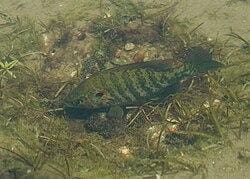
Warmouth (L. gulosus)
Warmouth are like other panfish, but they have a red eye and a large mouth. There are dark lines radiating from the eye that look like war paint, hence the name. Warmouth swim in swampy, still, darker water than other sunfish. They spawn all summer, building solitary nests next to submerged objects. Warmouth eat crayfish, insects, and fish, mostly in the morning. They are ambush predators, hiding in vegetation and then aggressively attacking prey. They appear to sleep at night.
The same baits and lures work for warmouth as for other sunfish, just in muddy waters.
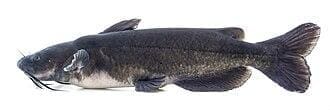
Channel catfish (Ictalurus punctatus)
Catfish are hard pulling fish that live deeper in lakes and are active after sunset. Chicken and beef liver, and worms are good baits because catfish smell to find food in the dark lake bottoms. Catfish have taste buds all over their bodies to help them locate food but they do not eat decaying materials or detritus. They eat crayfish and mollusks.
Males become darker, with dark lips and a swollen head, while females become lighter during the summer spawning season.
Adults are 20 inches long. Meat is white, crisp, tender, and tasty. Catfish are for eating. Fish on the bottom with a sturdy #2 to #4 hook and a heavy split shot sinker. FWC stocks catfish in Juniper Lake, Walton County.
Where to fish?
Sunfish are in any year-round rivers, streams, backwaters, and ponds, with larger fish in larger water bodies. The Yellow and Choctawhatchee Rivers are sure to please. Fish where tributaries enter the larger rivers, especially Holmes Creek, a spring-fed tributary of the Choctawhatchee. Sunfish love cover. Anywhere around logs, stumps, vegetation, or stuff in the water is where they are.
Juniper Lake, in Walton County, is periodically stocked with catfish, bass, bream, and crappie. Bass may be a bit farther out in colder water in summer, and catfish are on the bottom.
Florida summers are hot, but the fish still bite. Opportunities for freshwater fishing abound. This is the perfect time for family fun, but teaching children to fish is more than fun. It is an education in patience, skill, and achievement. You are making memories, but you are also developing an appreciation for nature and encouraging responsibility for the protection of the environment. Family fishing produces self-confident, persistent, capable, problem solvers. Go outside and enjoy the Florida Panhandle.
Helen Petre is a retired biologist. Any ideas or suggestions for articles about nature, wild things, and science, please email: petrehelen@gmail.com.
 RSS
RSS