






















Jeremy Ridley woke up confused in a hospital room at Ascension Sacred Heart Bay. He knew he’d been in a wreck, but not that he was fighting for his life. The collision had crushed his pelvis and broken nine ribs. Inside his chest, his aorta had torn open, a trauma that can claim lives in an instant.
“A heart attack is a plumbing problem. Something is clogging the pipes,” explained Dr. Richard Eubanks, a cardiothoracic surgeon at Ascension Sacred Heart Bay. “A dissection is the pipe splitting open.”
The surgical team had to act fast to save Jeremy’s life. Dr. Eubanks and his team chose a minimally invasive approach. They threaded a specialized stent through the groin to seal the tear from the inside, allowing a faster recovery from the procedure.
Due to multiple severe traumatic injuries, Jeremy spent months in the hospital and rehabilitation. He had to relearn to walk. Although his recovery was long and difficult, he persevered, running 5K races as soon as he was physically able.
“I can see God’s hands in everything,” Ridley said. “He put us in the right place at Ascension Sacred Heart Bay, and gave the care team the wisdom to save me. I wouldn’t be here without them; it’s just amazing.”
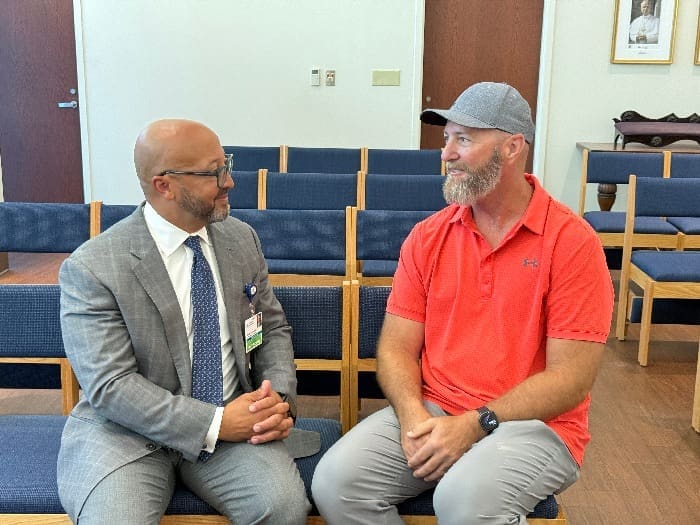
Jeremy’s recovery is remarkable, but aortic dissections occur more often than most people realize. Dr. Eubanks treats roughly 15 to 25 cases in this region each year. High blood pressure is the primary driver of this condition. He urges adults to target a blood pressure below 130/80.
“Know your numbers,” Dr. Eubanks advised. “Use a home blood pressure cuff and keep a simple log to track trends.”
Unlike a heart attack that builds slowly, a dissection feels like a light switch. Pain hits maximum intensity in an instant. Because the aorta runs the length of the torso, symptoms often confuse patients. While some might feel back pain or stroke symptoms, another feels chest pressure.
If you or someone else experiences sudden tearing pain, don’t drive. Call 911 immediately. Untreated, the risk of death from aortic dissection increases every hour.
 RSS
RSS