























By Ed Offley
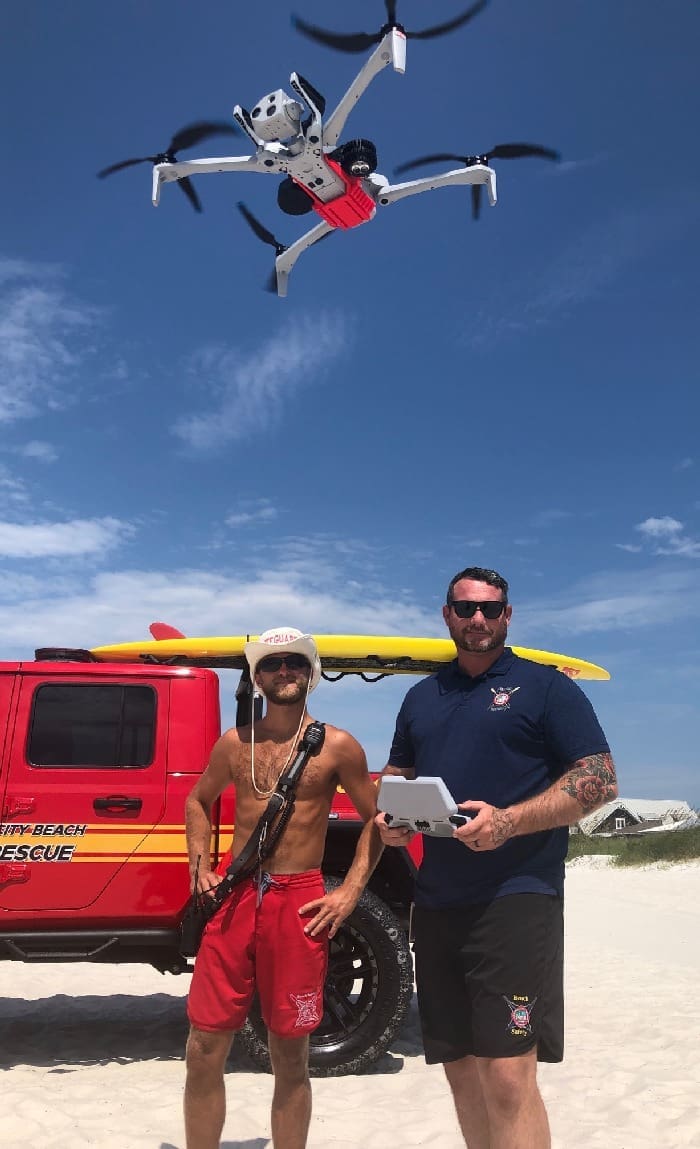
PCB Beach Safety Director Daryl Paul and lifeguard Teague Schmidt lay a square fabric platform on the sand, then gently place a SkyView drone on it. Picking up the control module, Paul launches the vehicle skyward, where it will give him a commanding view of the surf and any rip current formations difficult to identify from their location.
“We do this every day,” Paul said of the drone flight to monitor the surf conditions.

The $30,000 drone is one of two new technology devices acquired by the Beach Safety Division to enhance its rescue capabilities, Paul told PCB Life. The drone also features a thermal imaging capability that enables the rapid location of a distressed swimmer in the dark. In addition, lifeguards can now rapidly conduct underwater searches using a hand-held AquaEye active sonar system that can scan an acre of the seabed within seconds for a swimmer’s body that has fallen below the surface. The $6,000 device’s AI computer program can differentiate between a large fish and a submerged human body.
“Fortunately, we haven’t had to use that yet,” Paul said of the sonar device.
While enthusiastic about the improved technology, Paul said it is a more prosaic development that has the PCB lifeguard program hitting its full stride this year. City Council and the Bay County Convention & Visitors Bureau in recent years have boosted the division’s operating budget from just $400,000 in 2023 to $2.4 million this year – a sixfold increase.

That funding hike has allowed Paul to hire a lifeguard staff of 20 full-time employees. Not only does this allow year-round training for the lifeguards, but Paul has been able to extend lifeguard protection at the beach from its former termination date of October 1 to December 1.
“People are coming here year-round now,” he explained. “In 2025, we rescued a little boy on Thanksgiving Day.”
On a normal day, Paul deploys eight lifeguards along the city’s 9.6-mile Gulf beachfront from 8:30 a.m. until 6:30 p.m. This includes three stationed at two lifeguard towers on the protected beach at the Russell-Fields City Pier, and eight rovers patrolling the rest of the waterfront, including three lifeguards on jet skis. The division is organized into two shifts, with one working Wednesday through Saturday and the second active for four days beginning Sunday. On Wednesdays, both teams are active and conduct training in addition to patrolling the beach.
On major holidays such as July 4 and Labor Day, the division deploys the entire lifeguard force, with at least one lifeguard on patrol in each of ten designated beach zones to the east and west of the Russell-Fields protected beach, he said.
A combination of the expanded lifeguard presence and relatively mild surf conditions this year have resulted in only two drownings. No named tropical storms or hurricanes struck Panama City Beach in 2025 or this year as of August 31. The number of double-red-flag days dropped from 22 last year to just 11 as of mid-August this year.
However, the city lifeguard program’s increasing success, Paul said, is not measured solely in the number of actual rescues, but in the seemingly routine tally of “public assists” and “preventions” compiled during the tourist season.
In 2025 and 2026 (through mid-August), lifeguards rescued 23 and 29 swimmers respectively. “That’s where the person would have drowned if we had not responded,” he said.
That reduction, Paul said, reflects the beach safety division’s increased presence and a more proactive stance toward swimmers.
The number of “public assists” — where lifeguards observed a potentially dangerous situation involving a swimmer or beachgoer and intervened to prevent an emergency from occurring — is a more telling statistic, Paul added. This year to date, lifeguards were involved in 226 acts of assistance, significantly up from 181 in all of 2025.
Moreover, the number of “preventions” — where lifeguards interact with a beachgoer to inform them of potentially harmful rip currents, or a change in the beach flags, or other educational advice — is a solid indicator of the program’s effectiveness, he said.
In all of 2025, Beach lifeguards recorded 281,985 such encounters; as of mid-August, the number of “preventions” had exceeded 1.1 million.
“The numbers are really quite staggering to look at,” Paul said.
 RSS
RSS