















By Helen Petre
South of 98, on 293, almost to the beach, is a cemetery on 40 acres of pristine wild land. The cemetery offers burial sites, but it is also a unique ecosystem that is rare among the housing developments that surround it. Established in 1914 by Woodrow Wilson, the Choctawhatchee sand pines and gopher tortoises have been relatively untouched by human development or fire for an exceptionally long time.
The Historic Gulf Cemetery covers 40 acres of low hills and mature trees that make up a unique ecosystem dominated by Choctawhatchee sand pine (Pinus clausa immuginata). Sand pines grow on entisol soils, which are about 90% sand, and strongly acidic (pH 5). The soil is low in nutrients, lacking ammonium, phosphorus, potassium, calcium, and magnesium, and contains only about 1% organic matter, making it perfect for sand pines, but not for most other plants. Sand is excessively drained, making the soil very dry, even when it rains.
Choctawhatchee sand pines grow only on the coast of the Gulf of America, mostly in Walton and Okaloosa counties. In fact, they only grow within one degree of latitude. Most of their preferred habitat has been lost to development, making the cemetery habitat unique.
The sand in the cemetery, and along the Gulf coast, is of marine origin and was deposited in the Pleistocene as a series of ancient shorelines, forming long, gentle hills and flat ridge tops. This is a distinct community that is strikingly different than longleaf pine communities, which are higher in elevation and have more organic matter.
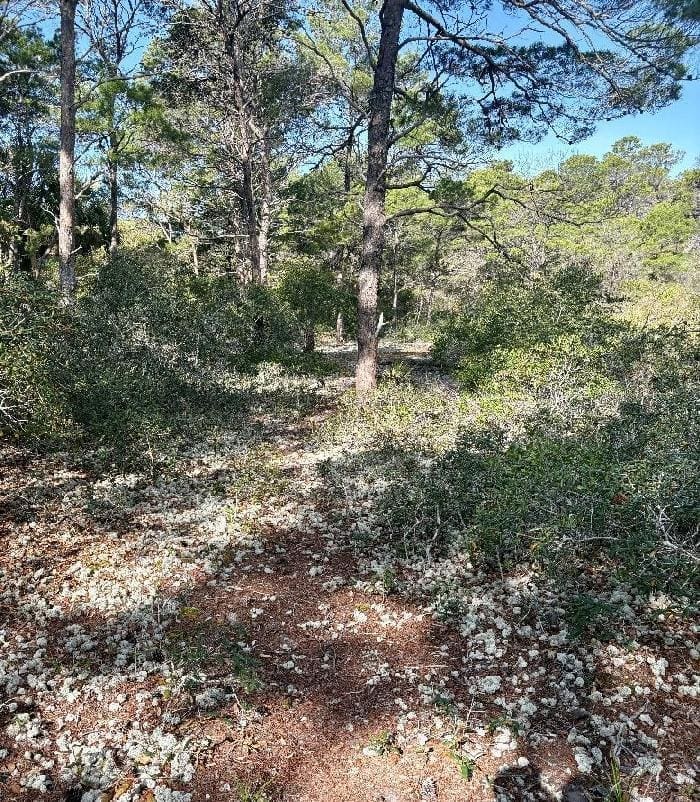
Since the cemetery is relatively protected from fire, Choctawhatchee sand pines thrive. The natural ecosystem, without fire, has an open canopy with sparse understory. Turkey oak, prickly pear cactus, wildflowers, and broadleaf grasses are the predominant plant species. Lichens are present in dense clusters on the infertile soil surface.
Lichens (Cladonia species)
The lichens in the cemetery are commonly called deer moss; large, puffy, gray-green fruticose lichens. They are a mutualistic relationship between a blue-green algae and a fungus, and look like pale green, round sponges. There are no roots, so the lichens just sit on top of the ground.
Fauna
The sand pine ecosystem provides abundant food and cover for wildlife. Wild turkey, gray squirrel, and mourning dove eat the seeds of Choctawhatchee sand pine. The open canopy provides habitat for woodpeckers, squirrels, and birds of prey. When I was there in March 2026, I saw an eagle, along with many songbirds and squirrels. There are bluebird boxes throughout the cemetery, and most are occupied.
Gopher Tortoise (Gopherus polyphemus)
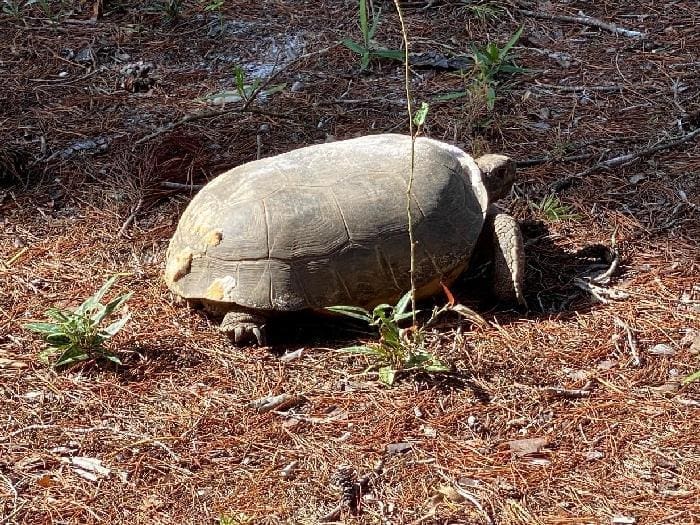
The gopher tortoise is an important resident of the Historic Gulf Cemetery. I saw three burrows in March 2026. Gopher tortoises are threatened by habitat destruction and need a very sandy substrate to dig burrows. They also need an open canopy in order for their preferred food, grass, to grow. About 75% of their diet is grasses. Gopher tortoises also eat wiregrass, gopher apple, blackberries, and palmetto berries, all present close to the burrows.
Gopher tortoises are seldom seen, as they spend 80% of their time in their burrows. Burrows average 15 feet long and six feet deep, and protect the tortoises from heat, cold, fire, and predators. The burrow provides homes for commensal species, including Florida mice, gopher frogs, and eastern indigo snakes. Gopher tortoises live for about 40 years.
The sand pine ecosystem in the cemetery is a uniquely wild environment that provides habitat and food for many species. A walk through the cemetery is peaceful and reflective, but it also allows visitors to experience a rare ecosystem in contrast to the surrounding housing and commercial developments. It is a special, protected home for some of my favorite native plants and animals. I am grateful there is a peaceful place for them to live quietly and respectfully, among a place for humans to rest in peace.
Helen Petre is a retired biologist enjoying her time in nature along the Gulf of America. If you have any nature questions, or suggestions for articles about our bio paradise, email petrehelen@gmail.com. William Keyes is the President of the Board of Directors of the Historic Gulf Cemetery.
 RSS
RSS