Creativity is making its way onto the roadways of Bay County, and the community is invited to help support it.
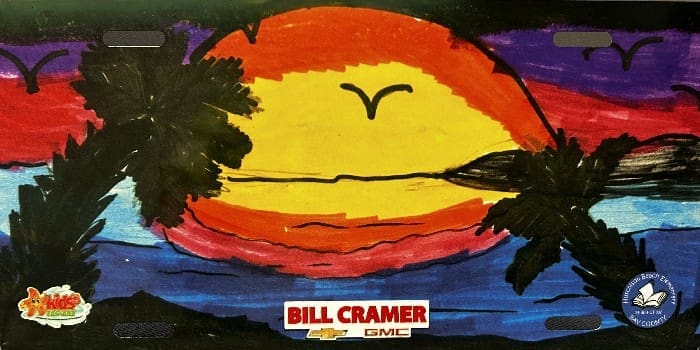
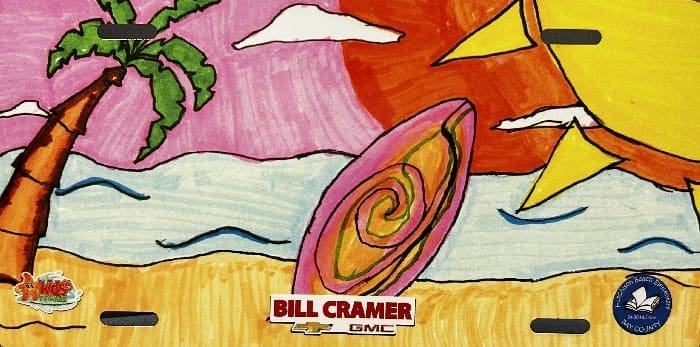
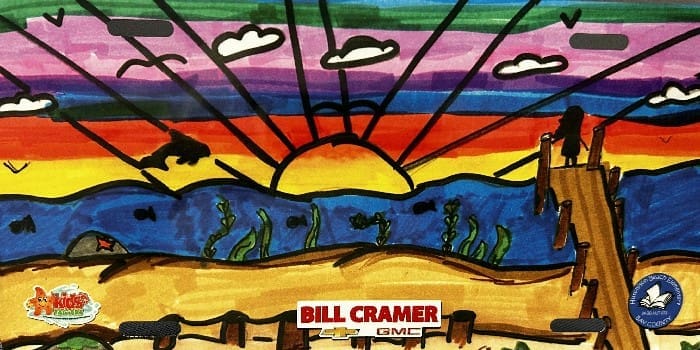
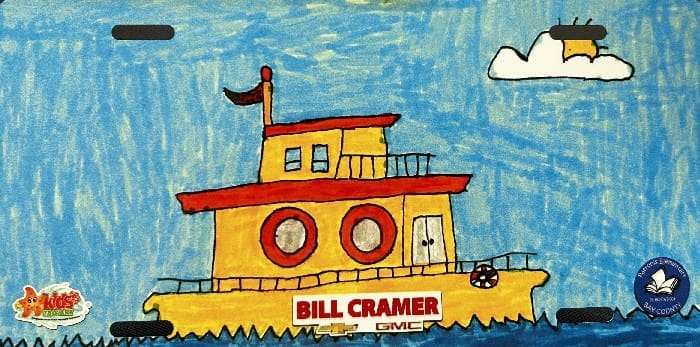
The Bay County Tax Collector’s Office recently completed its first year participating in the Kids Tag Art program. Kids Tag Art allows fifth-grade students to design their own colorful vanity-style plates, which family members and community supporters can purchase and display on vehicles, in homes, or offices. Funds raised go directly back to school art programs to help purchase supplies and support creative learning opportunities.
Originally launched in 2002 in Polk County, the initiative has grown to include 15 tax collectors across Florida and has raised more than $2.5 million statewide for school art programs.
1 of 5
Last year was the pilot year for Kids Tag Art in Bay County and more than $7,000 was raised for local elementary school art classrooms. Proceeds from community business sponsorships and the sale of student-designed decorative license plates supported art departments at Deer Point Elementary, Hutchison Beach Elementary, and Patronis Elementary.
This year, the program is continuing to grow locally with five Bay County schools participating: Breakfast Point, Deer Point, Hutchison Beach, Patronis, and Tommy Smith Elementary.
Local businesses have played an important role in helping the program grow. Community sponsors such as Bill Cramer GMC, Panhandle Engineering, Perry & Young Law, and PNC Entertainment helped make the pilot year possible.
Community members can continue supporting the young artists by purchasing a Kids Tag Art plate. Each purchase helps ensure that local classrooms have the materials students need to explore their creativity.
For families, friends, and community supporters, it’s a simple way to showcase local talent while investing in arts education.
If you’re a business interested in being a sponsor for the Kids Tag Art program, please reach out to Kids Tag Art Coordinator Kara Stallings at (850) 248-8515.
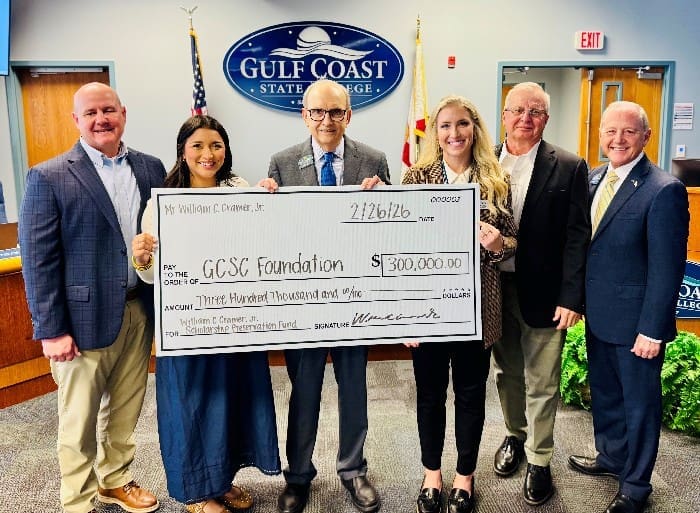
Panama City, FL – Gulf Coast State College (GCSC) announces a $300,000 gift from Mr. William C. Cramer, Jr. to establish the William C. Cramer, Jr. Scholarship Preservation Fund, ensuring continued support for hundreds of GCSC students.
The contribution was made following a recent review of scholarship award allocations for the upcoming academic year, during which the recommended scholarship payout exceeded the Foundation’s endowment distribution policy. While the increased awards reflected the College’s commitment to expanding student access and opportunity, the overage required additional funding to maintain long-term endowment sustainability.
“Mr. Cramer’s generosity ensures that our scholarship program remains strong and sustainable,” said Ashlin Glatthar, Executive Director of the Gulf Coast State College Foundation. “His commitment allows us to uphold our stewardship policies while continuing to make meaningful investments in the lives of our students.”
Mr. Cramer’s $300,000 gift fully offsets the projected overage and preserves funding for 784 scholarship opportunities.
“A scholarship forever changed my father’s life. I’ve had the privilege of serving nearly forty years as a member of the Gulf Coast State College Foundation, watching it do the same for thousands of students,” Shared Mr. Cramer. “This gift supports general scholarship funding for the coming year so that every eligible student continues to receive the support they need.”
Gulf Coast State College extends its sincere appreciation to Mr. Cramer for his leadership and dedication to student success.
About the Gulf Coast State College Foundation The Gulf Coast State College Foundation is dedicated to transforming lives through education by providing scholarships, program enhancements, and direct student support. Through the generosity of community partners and donors, the Foundation helps remove financial barriers and empower students to achieve their academic and professional dreams. To learn more, apply for scholarships, or make a gift, visit www.gcscfoundation.org.
For more information, please contact Dayna Headrick, Communications Manager: dheadrick@gulfcoast.edu or (850) 872-3815
Gulf Coast State College is excited to announce that registration for the 2026 Summer Youth Programs is open.
Through these programs, GCSC offers a variety of academic enrichment camps and activities for youth ages 4-16 who live in Bay, Gulf and Franklin counties. Each program is designed for kids who are enthusiastic about the opportunity to learn and participate in fun, hands-on and challenging activities. Programs vary to cover different topics of interest, such as environmental science, engineering, biology, robotics, technology, and unmanned vehicles. The College will host athletic and culinary camps as well.
All summer camps will be offered at the Panama City Campus of Gulf Coast State College with camps beginning in June. Please check the specific camp information for the exact dates and topics. To register your student for GCSC Youth Programs, visit: gulfcoast.edu/youthprograms.
For additional information, please contact Katie McCurdy at kmccurdy2@gulfcoast.edu or (850) 872.3814.
November Up 7%, December Up 10.7% as Destination Reports Nearly 8% Fiscal Year Growth
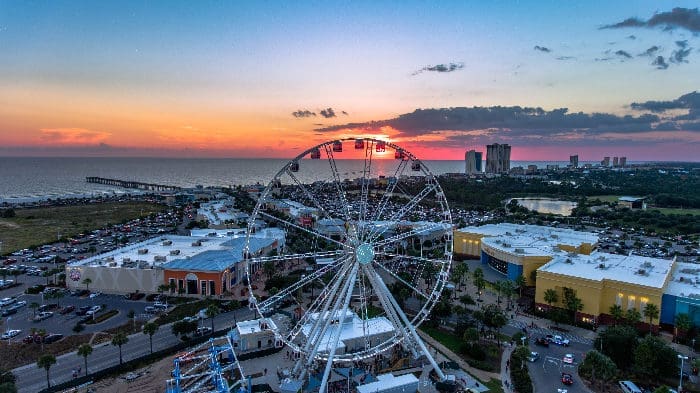
The Panama City Beach Convention & Visitors Bureau (CVB) and the Bay County Tourist Development Council (TDC) announce collections for the month of November 2025 were up 7% compared to November 2024, followed by a 10.7% year-over-year increase in December 2025. The destination is now up 7.8% for the fiscal year to date, which began in October 2025, reflecting sustained momentum through the late fall and early winter months.
“Seeing visitation growth in months traditionally considered a shoulder season across Florida reaffirms our long-term tourism strategy,” shares Jayna Leach, Senior Vice President and CMO of Visit Panama City Beach. “By driving national and regional visitation year-round, we’re strengthening the economic vitality of our community and creating meaningful impact for local businesses. We’re excited to build on this momentum as we welcome new and returning visitors throughout 2026 and beyond.”
The November increase reflects a diversified approach to visitation, driven by both large-scale events and lifestyle programming designed to extend the season. Sports tourism continued to contribute to the destination’s success, with major tournaments and events bringing teams and families to Panama City Beach during traditionally quieter travel weeks.
Meanwhile, seasonal initiatives like Beach Home for the Holidays—a program characterized by festive décor, community events and beachside programming—enhanced quality of life for residents while welcoming winter residents and extended-stay visitors. Together, these efforts encouraged longer stays, repeat visitation and sustained momentum throughout the late fall and early winter months.
The December increase was further supported by holiday travel and signature winter events such as the annual Beach Ball Drop, which once again ranked among the top 10 in USA Today’s 10Best Readers’ Choice Awards for New Year’s Eve Beach Ball Drops nationwide.
Back-to-back monthly growth and nearly 8% fiscal year-to-date gains underscore the effectiveness of the TDC and CVB’s efforts to appeal to locals, families, winter residents and extended-stay visitors.
The Tourist Development Tax is a five percent tax on short-term rentals including hotels and condominiums. The tax funds are used for marketing and promotional activities led by the Panama City Beach Convention & Visitors Bureau. It is also used for beach cleaning and grooming, product improvement and beach renourishment. For more information on Panama City Beach visit www.visitpanamacitybeach.com or the Bay County Clerk website https://tdc.baycoclerk.com/TouristTax/ to learn more about the bed tax.
The City of Panama City Beach is now accepting applications for the 2026 Citizens’ Academy program. Citizens’ Academy is a nine-week educational program designed to give residents an inside look at City government operations. The academy aims to engage citizens by providing in-depth information about their local government, helping them expand their knowledge and potentially prepare for future roles as board members, commissioners, or elected officials.
The program will take place on Wednesday evenings from 5:30 – 7:30 p.m. from June 3 through July 29. Participants will gain valuable insight into how decisions are made and be honored with the official title of “City Ambassador”. They will receive a certificate and a PCB Citizens’ Academy shirt upon completion.
Panama City Beach residents ages 18+ may apply online through April 24. Class size is limited to 20 participants on a first-come, first-served basis. For more details on the program and to apply online, please visit: https://www.pcbfl.gov/427/Citizens-Academy
By Cindy Mulla, Public Relations & Education, Beach Mosquito Control District
Well, to be honest with you, the mosquitoes have been present all winter long. What!?
Even if you live in an area where there are months of extreme weather conditions such as deep freeze or drought, mosquitoes persist. Insects like mosquitoes have amazing strategic adaptation methods that help them survive even the harshest of weather conditions. There are four stages in the mosquito life cycle: egg, larva, pupa, and adult, and the first three stages are water-dependent. Only three parts of their life cycle can survive winter successfully. The name of this significant metabolic reduction of growth is diapause. It is a temporary suspension of development or dormancy from one stage to the next and triggered by environmental factors such as temperature, amount of daylight and stress on the insect.
As fall arrives, only a select few species of adult females will go into diapause. These mosquitoes will search for a damp, warm location like a sewer, basement, barn, or hollow log to rest and use their stored fat for energy. Even gravid mosquitoes with eggs will survive. Male mosquitoes will not go into diapause and will die off. Remember, it is only the female that bites and takes a bloodmeal. She uses the protein from the blood meal to develop her eggs. From just one drop of blood, each female mosquito can produce a clutch of 250 to 300 eggs at once and can lay twice during its lifetime. Certain genera of mosquitoes will lay their eggs individually, in smaller batches, in multiple locations, and these can survive up to a maximum of two years. The aquatic larval stage will also enter diapause to survive. During this stage, the larvae’s metabolic rate, which includes heart rate and respiration, will slow down, stopping further development. Their food source will come from stored nutrients. As soon as environmental temperatures rise, and days become longer, these three stages of development will resume as normal. Temperature is a key factor for controlling the rate of development for mosquitoes. The higher the water temperature is, the quicker the development turnaround time is from egg to adult.
Not to gross you out but… Did you know that when she stealthily bites you, she must first inject her saliva into your body to function as an anticoagulant so she can successfully take a blood meal from you? Yuck! Before you realize it, there is a raised, red, and itchy bump. This is an allergic reaction to her saliva. How nasty!
No matter what blood type you are A, B, or O, positive or negative, she will still find you! She prefers a warm blood meal and can sense body temperature. She loves stinky smells. This little vampire certainly is attracted to sweat (It contains lactic acid that makes us all smell unpleasant), the scent of the bacteria on your skin and especially the moist carbon dioxide we exhale too. Unfortunately, we cannot win! She also loves sweet smells like perfumes, colognes, and deodorants. She is a tiny pollinator, loves nectar from flowers and gets her energy from carbohydrates.
Please, take precautions to avoid being bitten by the female mosquito. She is the queen for being the most dangerous living creature on earth due to the life-threatening diseases she can transmit. Only infectious females can transmit disease when they bite. Viruses found in Florida include Chikungunya (CHIKv), Dengue (DENv), Zika, Eastern Equine Encephalitis (EEEv), St. Louis Encephalitis (SLEv), and West Nile Virus (WNV). Chikungunya, Dengue and Zika are traditionally imported infections with possible local transmissions that can occur. All can be transmitted to humans. There are no preventive vaccines available for humans. It can take from 2 to 15 days after receiving a bite from an infected mosquito for illness symptoms to appear. They usually mimic flu symptoms such as fatigue, fever, headache, dizziness, muscle weakness, joint pain, or a rash. If you or anyone you know is experiencing these symptoms, please seek medical treatment promptly. A physician can order a laboratory test to determine if the illness is caused by an arbovirus (a virus transmitted by an insect or tick). However, most people infected with an arbovirus do not even become ill.
Regardless, please always take preventive steps against the bite of the female mosquito. Wearing light colors will help because it is much easier for her to see darker colors due to her eyesight. When outdoors, always use an Environmental Protection Agency (EPA) approved registered product and follow the label instructions. The smell of the repellent confuses her sent receptors located on the antennae and throws her off our natural attractants. Try to stay indoors during dusk and dawn hours. These times are the active peak mosquito transition feeding times and especially for the key mosquito species that are notorious for transmitting disease. It is also especially important to get rid of all standing water on your property to eliminate mosquito breeding sites. If you have exhausted all your strategies and are still having mosquito problems and live in the Panama City Beach area, contact Beach Mosquito Control District. We encourage you to contact us. We will inspect, treat, and share preventive strategies with no additional cost. Your annual tax dollars cover the cost of our services. We determine our larger area treatments by the number of service requests we receive from the citizens, and the number and specific species we catch in our surveillance traps. Communication is key. We do not know how bad the mosquitoes are on your property unless you contact us. We are here to serve you. Please place a customer service request by phone at (850) 233-5030 or online at www.pcbeachmosquito.org.
Spring Reading Challenge April 1 – 30
Check out items in April to be entered in a raffle prize drawing! (1 entry per person) There will be one small prize for kids, one for teens, and one for adults.
Find a Flamingo April 19 – 25
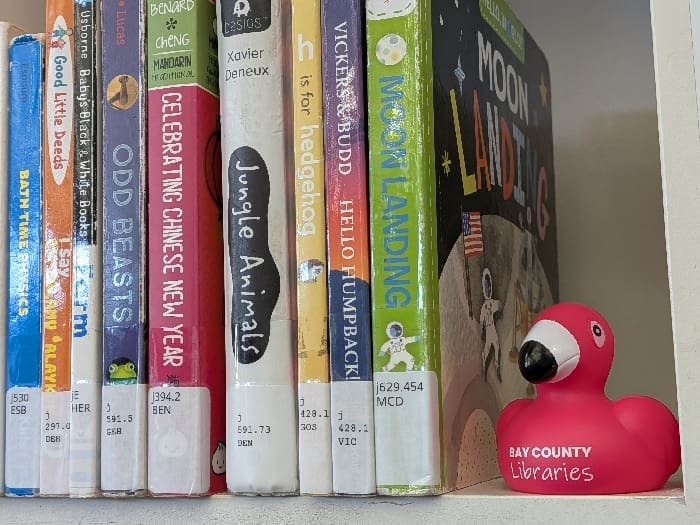
Flamingos have flocked to the library! During National Library Week, keep your eyes open as you browse the stacks. You might just find a flamingo! If so, the flamingo is yours to keep and you can visit the circulation desk for another small prize. (while supplies last)
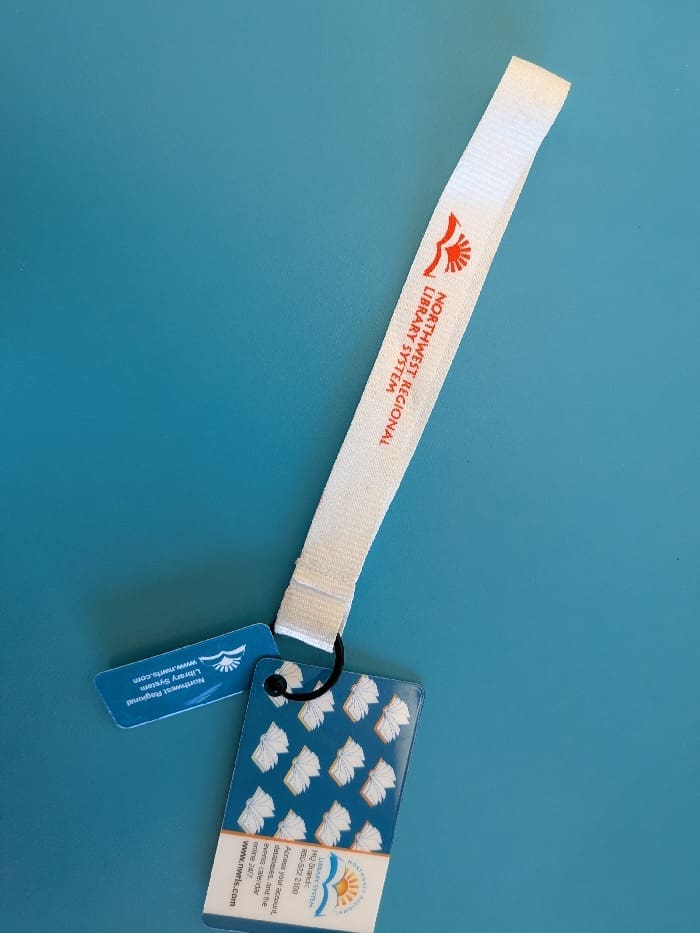
Library Members April 19 – 25 All library card members who visit during National Library Week will receive an NWRLS-branded book bag! All NEW library card members will receive the branded tote and an NWRLS keychain! (while supplies last)
Panama City Beach Public Library April Programs
1 of 3
Book Babies (Ages 0 – 2)
Tuesdays through May 26 at 10 and 10:30 a.m. CT (same class)
Stop by for delightful stories, songs, play! (Space limited to 24 people per class)
Sail Into School (Ages 3 – 5)
Thursdays through May 28 at 10 a.m. CT
Get ready to learn with engaging stories, songs, and crafts! Visit the front desk for an entry ticket. (Space limited to 24 people)
LEGO Club (Ages 7 – 11)
April 14 at 3:30 p.m. CT
Make new friends while creating cool, themed LEGO builds! *Registration begins on the 1 of the month
Sea Needles
Fridays at 10 a.m. – 12 p.m. CT
Join us and make new friends as you work on your own sewing project. Stop by our display case to see some of the beautiful, finished projects.
Movies @ the Park: Zootopia 2 (PG) (OFF-SITE)
Friday, April 17 at 7:30 p.m. CT
Harder’s Park, 8110 John Pitts Rd, Panama City, FL
Join us for a free family movie night at Harder’s Park! Attendees will even be entered into a raffle to win a small prize! This community program is brought to you by Bay County Public Library and Bay County Parks & Recreation. This event is partially funded by the Friends of the Bay County Public Libraries and the St. Joe Foundation. Don’t forget to bring a blanket or chair for seating!
WJHG Chapter Chat
April 28 at 2 p.m. CT
Join Jessica Foster from WJHG News Channel 7 to discuss our monthly read! Follow Facebook and WJHG for the title of the month. Refreshments provided. Extra copies of the monthly title are provided by the Bay County Public Library Foundation.
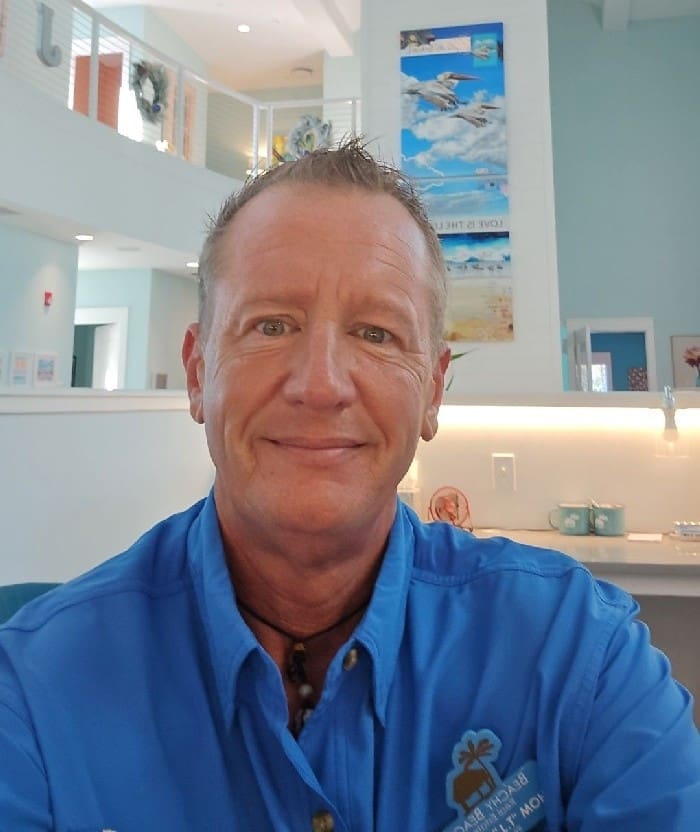
Thom Kindos was born into a strong Greek family. His grandfather came to New York City from Greece, and as a kid, Thom remembers being completely immersed in the Greek culture. They went to Greek festivals, attended Greek Church, and ate Greek food. He and his parents moved to Florida in 1986 when Thom was 11, and opened a restaurant in Panama City Beach in 1989. It was located on Front Beach Road, where the former Eldorado Motel was. After a year and a half, another restaurant owner over in Inlet Beach was retiring and asked Thom’s parents if they’d be interested in buying her out. They did. For the next 30 years, they continued to build relationships with the locals, knowing practically everyone by name who came through the door each week and striving to offer a superior level of food quality, presentation, and service. Thom remembers working with his grandmother in the kitchen at a young age, even before he really began helping in his parents’ restaurants. He credits those years with making him an excellent potato peeler now.
At age 19 or so, Thom felt the need to break away on his own. He thought pretty seriously about going to school to be a physician, but decided his grades really weren’t quite good enough for that. One thing he already knew how to do, though—and do it very well—was cook. So he went off to West Palm Beach and graduated from the Florida Culinary Institute.
He feels like book knowledge is great, but you’ll never learn as much as you will from actual hands-on experience. He worked in a few restaurants over the next several years, but the combination of prolonged stress and many 18-hour days started causing him both physical and emotional pain. This eventually led to some issues with alcohol abuse. After a while, it began to affect his ability to work or even keep a job. He’s very thankful for all the people who planted seeds, encouraging him to reprioritize his life and make changes. He’s now been sober for eight years. His recovery has been a big part of his personal journey and he’s very open to helping anyone else who might need someone to talk to or share resources to help them. He feels like he’s been given a brand new life now.
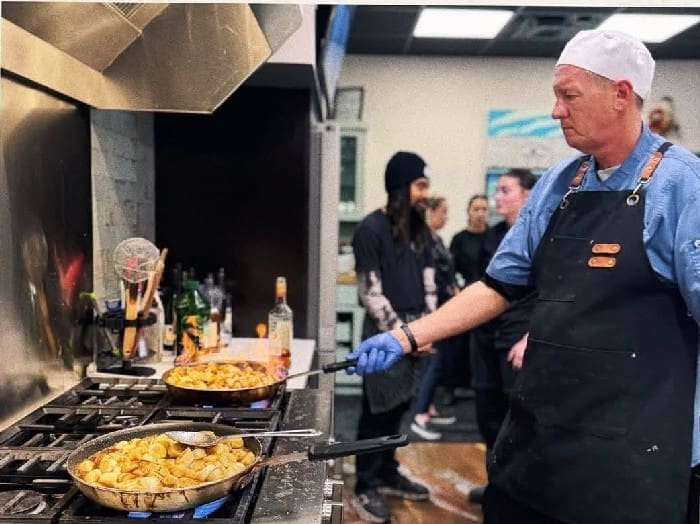
In 2021, he decided to take the necessary classes to get his real estate license—after a friend and local realtor “double-dog-dared” him to. Thom now represents Beachy Beach Realty in Panama City Beach and enjoys helping people solve problems. Every day is different and presents new challenges, and Thom has brought many of the things he learned from his parents’ successful restaurant business—like customer service and building relationships—to his current career. He still loves to cook, though, and now teaches cooking classes 2-3 times each month at Somethin’s Cookin’ Downtown. You can watch him work and ask questions while he fixes a variety of appetizers, main courses, and desserts. You can also catch one of his videos when you search “The Realtor Chef” on YouTube.
When Thom isn’t in the kitchen, you might find him on a golf course, out on the water fishing, hanging out on Shell Island, or getting back into playing the trombone (which he did from middle school through early college). One of his favorite things to do is relax in the backyard at his new home, whether he’s doing landscape projects or just enjoying the peaceful atmosphere. It’s his personal retreat.
To find out how to make Thom’s favorite stuffed flounder or crab cakes, or to connect with him about any of his other ventures, you can email him at thom@beachybeach.com.
There are many signs of spring in the air; crowded beaches, the sound of lawnmowers starting up after their winter hiatus, new blooms and accompanying allergies. As you begin your spring plantings, did you know that Florida Statute (F.S.) protects Florida-friendly landscaping in Homeowners Association neighborhoods?
Under F.S. § 373.185, Homeowners Associations may not enforce covenants which prohibit property owners “from implementing Florida-friendly landscaping on his or her land.”
The statute defines “Florida-friendly landscaping” as “quality landscapes that conserve water, protect the environment, are adaptable to local conditions, and are drought tolerant. The principles of such landscaping include planting the right plant in the right place, efficient watering, appropriate fertilization, mulching, attraction of wildlife, responsible management of yard pests, recycling yard waste, reduction of stormwater runoff, and waterfront protection.”
The governing documents of my own neighborhood’s HOA even contain a provision on Florida Friendly Landscaping. According to the community’s charter, the HOA “shall encourage best management practices cited by the University of Florida in the Institute of Food and Agricultural Sciences’ “A Guide to Florida-Friendly Landscaping” for landscape installation, irrigation, and fertilizer and pesticide applications as to the Units…”’
However, as with anything, the devil is in the details, and F.S. § 373.185 is not a carte blanche pass allowing homeowners to completely ignore an HOA’s rules regarding landscaping.
HOAs may still place restrictions on the manner and appearance of Florida-friendly landscaping, so long as those restrictions do not effectively prohibit it altogether. For example, associations may adopt reasonable guidelines regarding design, placement, and maintenance, including requirements for neatness, defined borders, or approval of a landscaping plan before installation. HOAs may also regulate issues such as visibility at intersections and drainage concerns. In practice, this means that while a homeowner may have the right to incorporate native plants or reduce turf grass, they are not free to create an unmaintained or aesthetically inconsistent yard that conflicts with legitimate community standards. The balance struck by the statute allows for environmentally conscious landscaping while preserving an association’s ability to maintain a cohesive and orderly neighborhood appearance.
In situations where an HOA wrongfully denies a homeowner’s landscaping application, the unfortunate reality is that potential litigation costs may dissuade homeowners from exercising their rights to Florida-friendly landscaping. Even when a homeowner is legally in the right, the prospect of hiring counsel, responding to enforcement actions, or pursuing declaratory relief against an HOA can be both time-consuming and expensive. Additionally, under Florida Statutes § 720.305, the prevailing party in an HOA dispute is entitled to recover reasonable attorney’s fees and costs. While this allows a successful homeowner litigant to recover litigation costs, the prospect of having to pay the association’s costs, if the homeowner were to lose, could serve as a deterrent to pressing one’s rights.
If you are interested in learning more about Florida-friendly landscaping, there are many excellent resources available. Organizations such as the Florida Native Plant Society provide education, plant guides, and local chapter support focused on using native species. For those looking for inspiration and practical guidance, Backyard National Park promotes the idea of turning residential landscapes into thriving habitats for wildlife. Locally, nurseries like Sandhills Native Nursery specialize in plants that are well-suited to Bay County’s soil and climate conditions. Homeowners can also consult the University of Florida Institute of Food and Agricultural Sciences, which offers research-based publications and often hosts workshops through its county extension offices. Together, these resources can help ensure that your landscaping choices are not only compliant with Florida law, but also sustainable, attractive, and beneficial to the local environment.
Jon Carroll is a licensed attorney. The information in this column is provided for educational and informational purposes only, and does not constitute legal advice, nor establish an attorney client relationship. Consult a qualified attorney in your jurisdiction for legal advice specific to your situation.
I volunteer at the E.O.Wilson Biophilia Center, helping Turtle Bob teach fourth and seventh-graders about snakes and turtles. When the students enter the Turtle Bob room, some are terrified. By the time the class is over, Turtle Bob has convinced even the most uneducated that snakes are our friends. All the snakes the students hold are non-venomous and accustomed to being held. We teach the students that they will encounter snakes in the wild if they go outside.
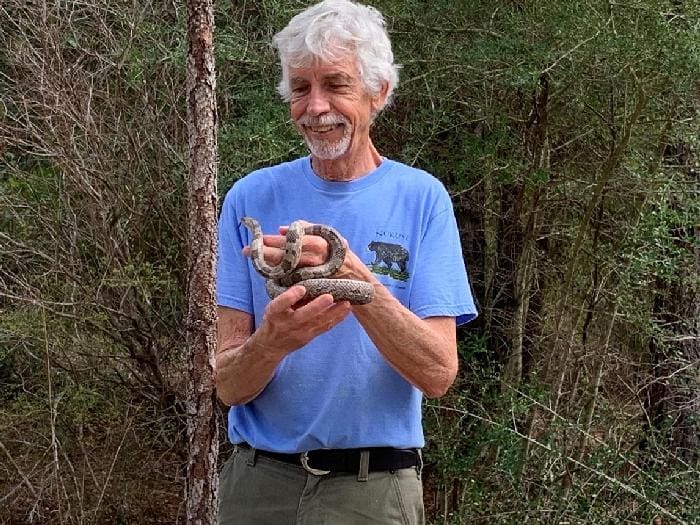
Turtle Bob and a gray rat snake, or oak snake (Pantherophis spiloides)
Most of our snakes in the Panhandle are non-venomous, but a few, like our common cottonmouth, are venomous. Even so, if you wear shoes and keep your hands where you can see them, you will be fine. Venomous snakes do not chase you down or attack you unless you try to kill them, step on them in bare feet, or pick them up. Like bears and bobcats, give them room, do not threaten them, and you will be fine. Any snake will bite if threatened. Any human probably will, too.
The cottonmouth is our most common venomous snake. It swims well, lives near water, and opens its mouth when threatened. Cottonmouths sometimes shake their tails when threatened, sort of like rattlesnakes. They are just trying to let you know they are there, and they hope you will go away. When cottonmouths are swimming, you can see their entire body on the surface of the water, unlike other water snakes.
Cottonmouths have big heads and skinny necks. They are very thick snakes with very thick tails. They look scary, but, unless you step on them in bare feet or try to kill them, they will not bite. Venomous snakes use venom to subdue prey. You are not prey. You are way too big to swallow. Bites are last resorts to make you go away.
Contrary to public opinion, cottonmouths are not aggressive. I almost stepped on one wearing flip flops (which is not a good idea), and the snake just sat there with its mouth open. Yes, I was terrified, but it did not bite. Bites are very uncommon, and although they are not fun, they are very rarely fatal.
Cottonmouths are food for eagles, owls, herons, alligators, kingsnakes, and snapping turtles. They eat fish and frogs. They are important members of an ecosystem that we want to preserve.
Cottonmouth. Wikipedia.
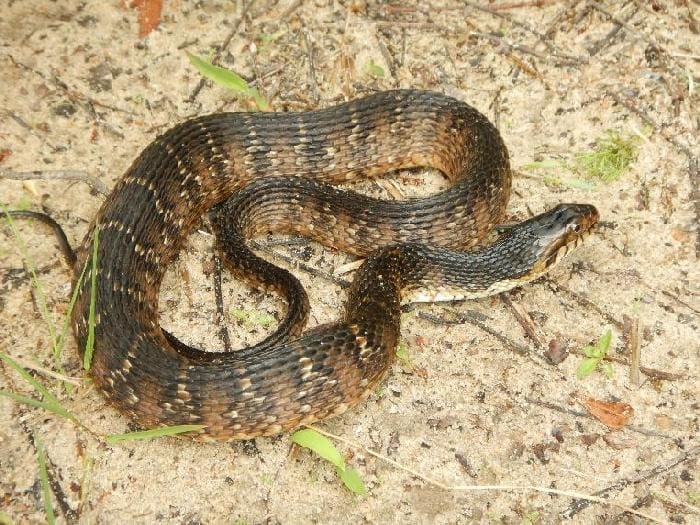
Banded watersnake (Nerodia fasciata)
Some snakes look like venomous snakes, and they do that on purpose. The banded watersnake is a common snake that lives near water like the cottonmouth, but it is not venomous. The banded water snake hopes you will think it is a cottonmouth and leave it alone. Sometimes that works. The difference is that banded watersnakes have long, pointed heads (not triangular), round eyes, they do not open their mouths when threatened, and you cannot see their entire body when they swim, only their heads. They, and especially their tails, are much thinner than those of a cottonmouth. They also have dark, vertical lines on their heads that are visible in the photo below and can be seen from a safe distance.
When a banded watersnake is threatened, it flattens out its head, but don’t be fooled. The head looks flat, not blocky like a cottonmouth.
Banded watersnake. Dr. Steve A. Johnson, UF/IFAS
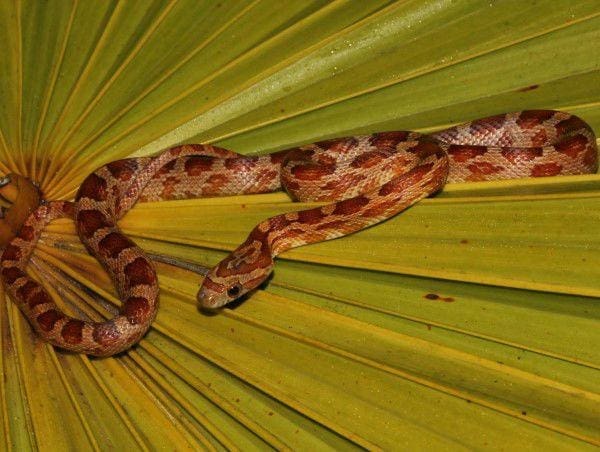
Red rat snake (corn snake, oak snake) (Pantherophis guttatus)
Red and gray rat snakes are also called oak snakes and corn snakes. They look alike except some are red and some are gray, or brownish. Red corn snakes are expert climbers. Some people think they look like copperheads, but copperheads are rare in the Panhandle.
Red rat snake. FWC.
Red and gray rat snakes are constrictors, but have no fear, they are way too small to strangle you. They constrict around a mouse, or other rodent when it exhales, and then it cannot inhale. It sounds terrible, but death is quick. Rat snakes are useful to control rodent populations and are beneficial to humans because rodents carry ticks and disease and spoil human food. Rat snakes live about 15 years in the wild in palmetto flatwoods and forests.
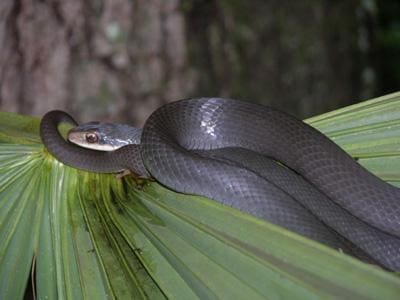
Black racers (Coluber constrictor)
Black racers, or black snakes, are probably the most common urban snake. They are active during the day, so they are often seen. Black snakes live around freshwater and under shrubs. They eat insects, frogs, and toads. They are also slightly hyperactive and large, so they tend to move quickly and scare people. They do not do well in captivity because they cannot tolerate life in a small box.
Black racer (black snake). Dr. Steve A. Johnson, UF/IFAS.
What to do if you see a snake
Nothing. Move away. Give the animal room and take a deep breath. The snake does not want to chase you, bite you, or eat you. It wants you to go away. So go away.
There is no good reason to kill a snake, and if you try, it might not end well for you. If you have snakes in your yard, it is probably because there is food: rodents, bird seed, or pet food. Remove the rodent food and the rodents and the snakes will leave.
Snakes are assets to our environments. They eat mice, rats, and other things that we do not want around our yards. Snakes are food for owls, herons, snapping turtles, and alligators. Like all wild animals, they were here first, and despite the Adam and Eve story, they do not tell us to do bad things. They just want to be left alone to enjoy the sun and rodents. We love snakes at the Turtle Bob room, and we hope you love them in your yards and in the wild.
Helen Petre is a retired USDA biologist and college biology instructor. Turtle Bob is the turtle guy at E. O. Wilson. We both hope to share our passion for the longleaf ecosystem with all the wonderful people who live here. If you have any questions about science, nature, or the wild world of Florida’s Panhandle, email petrehelen@gmail.com


































 RSS
RSS