























By Lauren Goldsby
We get a lot of questions at the Extension office about lawns. Most people have one and take great pride in how it looks. Irrigation is one of the most important practices for maintaining a healthy lawn. Many of the problems we see can be traced back to improper watering. Most people tend to overwater their lawns, which can lead to shallow root systems, increased weed growth, and more disease issues. Watering only when your lawn needs it can also reduce how much money you spend on water and fertilizer. It also helps keep nutrients from washing out of the soil and into nearby waterways. Overwatering can rinse fertilizer away before plants can use it, allowing it to run into natural water systems.
There are a few key things to think about when irrigating your lawn. Three of the most important are how often to water, how much to water, and the best time of day to water.
How often you need to water depends on several factors and will change with the seasons. Grass type, shade, and soil type all play a role. Don’t worry, you don’t need to be a soil expert to know when to water. It is helpful, though, to learn how to spot signs that your lawn is dry. These signs tell you when it’s time to turn your irrigation system on. Common signs of a dry lawn include grass blades that fold in half lengthwise. This is the plant’s way of conserving water. The lawn may also appear blue-gray instead of green. One of the easiest tests is to walk across your yard. If your footprints stay visible instead of springing back, your lawn likely needs water.
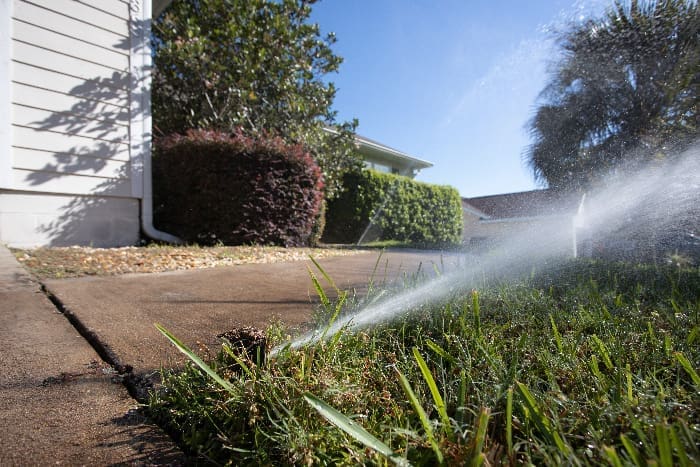
When you see these drought signs in about 30% of your yard, it is recommended to apply ½ to ¾ inch of water. Then wait until you notice signs of dry turf again before watering. This approach encourages deeper root growth and helps reduce weeds and disease problems. To know how much water your irrigation system is applying, it’s a good idea to calibrate it once a year. To calibrate your irrigation system, place several small containers of the same size throughout an irrigation zone. Turn the system on and let it run for 15 minutes. Afterward, use a ruler to measure how much water collected in each container. Add those measurements together and divide by the total number of containers to find the average amount of water applied. Use this information to determine how long you need to run your sprinkler system to apply the recommended ½ to ¾ inch of water during each watering cycle.
A common misconception is that lawns should be watered in the middle of the day when temperatures are the hottest. Watering at this time can lead to water loss from evaporation. Plants also take up water less efficiently when they are already stressed by heat. The best time to water is early in the morning. Watering in the evening can increase how long moisture sits on the grass overnight, which can encourage fungal and bacterial diseases. As we ease into summer, rainfall is expected to increase. Until that happens, these guidelines can help take the guesswork out of watering your lawn and keep it healthy while conserving water.
An Equal Opportunity Institution. UF/IFAS Extension, University of Florida, Institute of Food and Agricultural Sciences, Andra Johnson, Dean. Single copies of UF/IFAS Extension publications (excluding 4-H and youth publications) are available free to Florida residents from county UF/IFAS Extension offices. Contact our office at (850) 248-8091 or email legoldsby@ufl.edu. Follow us on Facebook @bayifas and Instagram @ufifasbay.
 RSS
RSS