

















By Lauren Goldsby
Coontie (Zamia integrifolia) is the only cycad native to the United States. Cycads often resemble palms, like the sago palm (Cycas revoluta), or ferns, as coontie does, but they are not closely related to either. These ancient plants have existed since the time of dinosaurs.
Today, coontie fits well into a wide range of landscapes and is commonly used in both residential and public spaces. It tolerates a variety of sun conditions, has high drought tolerance, and moderate salt tolerance, making it well suited for our area. Coontie grows slowly and doesn’t typically require much maintenance. Cold snaps may cause leaves to drop, but plants can survive temperatures below 20 degrees F.
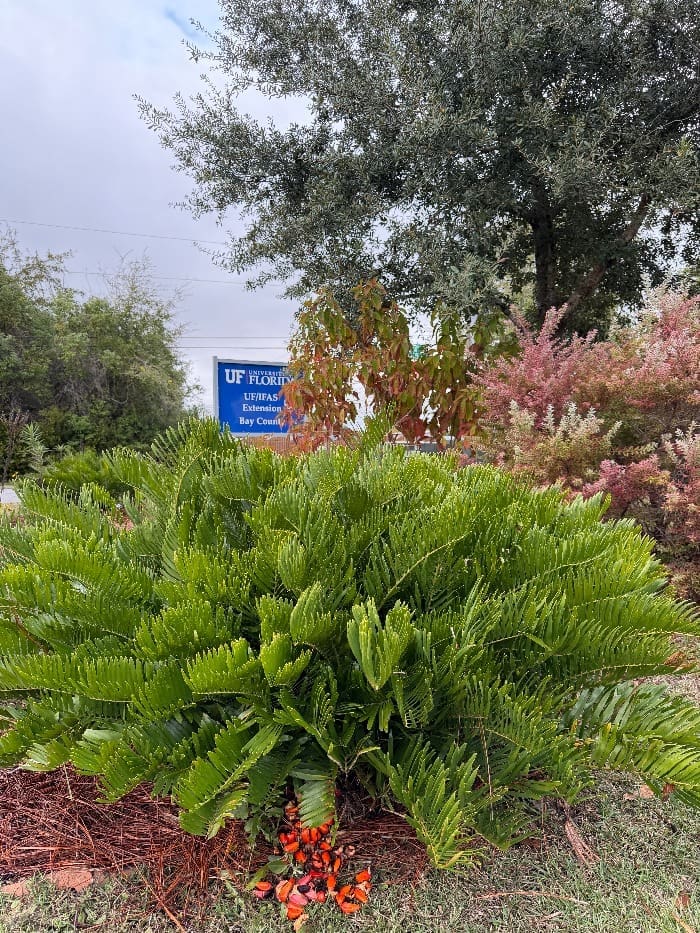
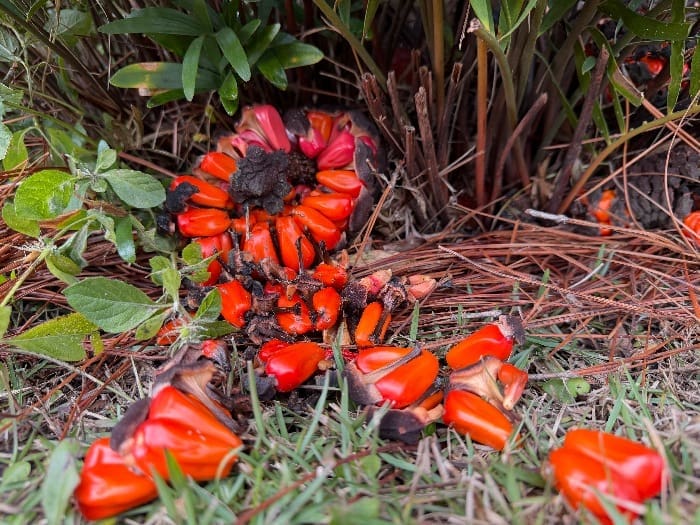
Unlike most landscape plants, coontie does not produce flowers. Instead, male plants produce pollen-filled cones, while female plants produce cones that contain seeds. These cones often go unnoticed, tucked into the crown of the plant, until winter, when the outer brown layer cracks open to reveal bright orange and red seeds inside.
Like other cycads, all parts of the coontie plant are toxic to mammals. If you have young children or curious pets, seed cones can be removed and discarded. Kept safely away from food items, seeds may also be collected, dried for several weeks, and stored until planting in spring. As temperatures warm, the fleshy seed coating can be removed, and seeds can be soaked overnight in water to help speed germination. Seeds left in the landscape may also germinate naturally over time.
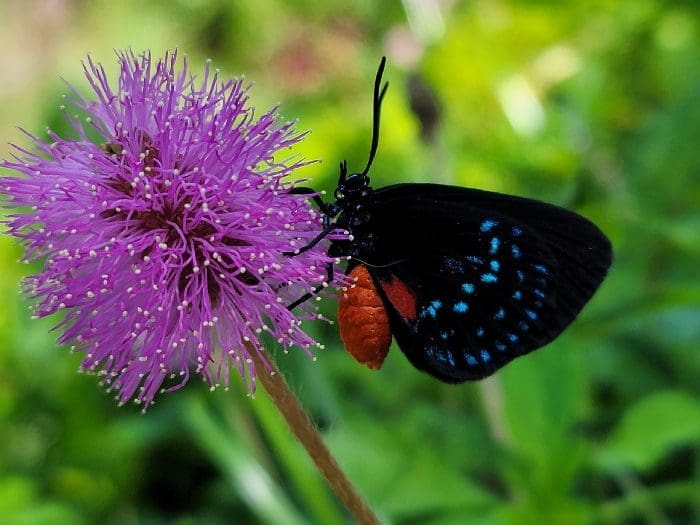
Much like the relationship between monarch butterflies and milkweed, the atala butterfly (Eumaeus atala) relies exclusively on coontie as its host plant. The toxins present in coontie accumulate in the caterpillars’ bodies, making them unpalatable to predators. Atala butterflies were thought to be extinct from 1937 until 1959 due to widespread loss of coontie habitat. Through focused conservation efforts and renewed planting of coontie, populations slowly began to recover. Today, atala butterfly colonies have been documented as far north as Gainesville, Florida.
While atalas are not yet common in our area, populations may continue to expand, particularly in coastal regions where suitable host plants are available. We’ll be keeping an eye on the coonties in our demonstration gardens for signs of caterpillars. Including coontie in your landscape may provide habitat for a passing butterfly and help support a small but meaningful piece of Florida’s native ecology.
An Equal Opportunity Institution. UF/IFAS Extension, University of Florida, Institute of Food and Agricultural Sciences, Andra Johnson, Dean. Single copies of UF/IFAS Extension publications (excluding 4-H and youth publications) are available free to Florida residents from county UF/IFAS Extension offices. Contact our office at (850) 248-8091 or email legoldsby@ufl.edu. Follow us on Facebook @bayifas and Instagram @ufifasbay.
 RSS
RSS